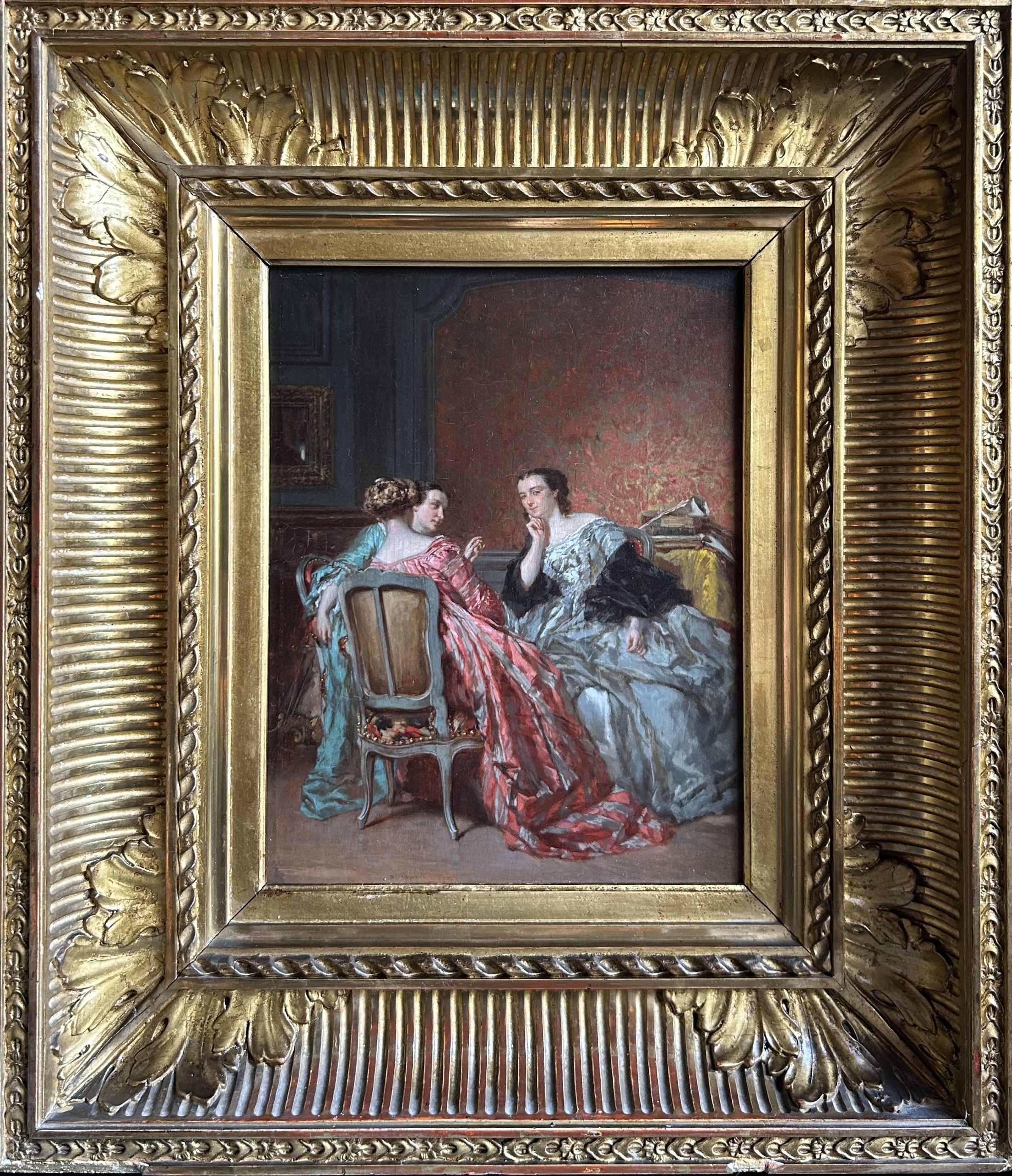

Oil on wood depicting a woman in front of a mirror applying a beauty mark, signed Henri Lafon, original wood and stucco frame.
Henri LAFON (active in France in the second half of the 19th century).
According to some sources, it was the Arabs and Persians who first considered brown spots on the skin a mark of beauty. Roman women, somewhat coquettish, also applied a small artificial beauty mark to their cheek to complete their attire. In France, the fashion for beauty marks began at the end of the reign of Louis XIII and lasted until the Revolution. They were worn primarily by the aristocratic elite. They were worn by both men and women.
They were generally made of silk, velvet, or black taffeta, and wearing one was a sign of high social status. The beauty patch conveyed messages in an era when pomp and formality dominated court life. More than just makeup, the beauty patch served as a means of self-expression and non-verbal communication.
It was in the 18th century that beauty patches became true symbols of femininity. They conveyed messages depending on their placement on the face and their shape.
A beauty patch near the eye signified a romantic and passionate person, one on the cheek indicated bravery and audacity, and one near or at the corner of the mouth represented flirtation or seduction.
The symbolism became even more nuanced depending on its shape.
For example, a round beauty patch signified simplicity and modesty, while a star-shaped one represented dignity and an aristocratic air. In the shape of a moon, it evokes a dreamy and sentimental side. And in the shape of a triangle, it represents discretion and mystery.
19th century,
France
Height with frame: 40 cm; without frame: 21 cm
Width with frame: 35 cm; without frame: 15.5 cm