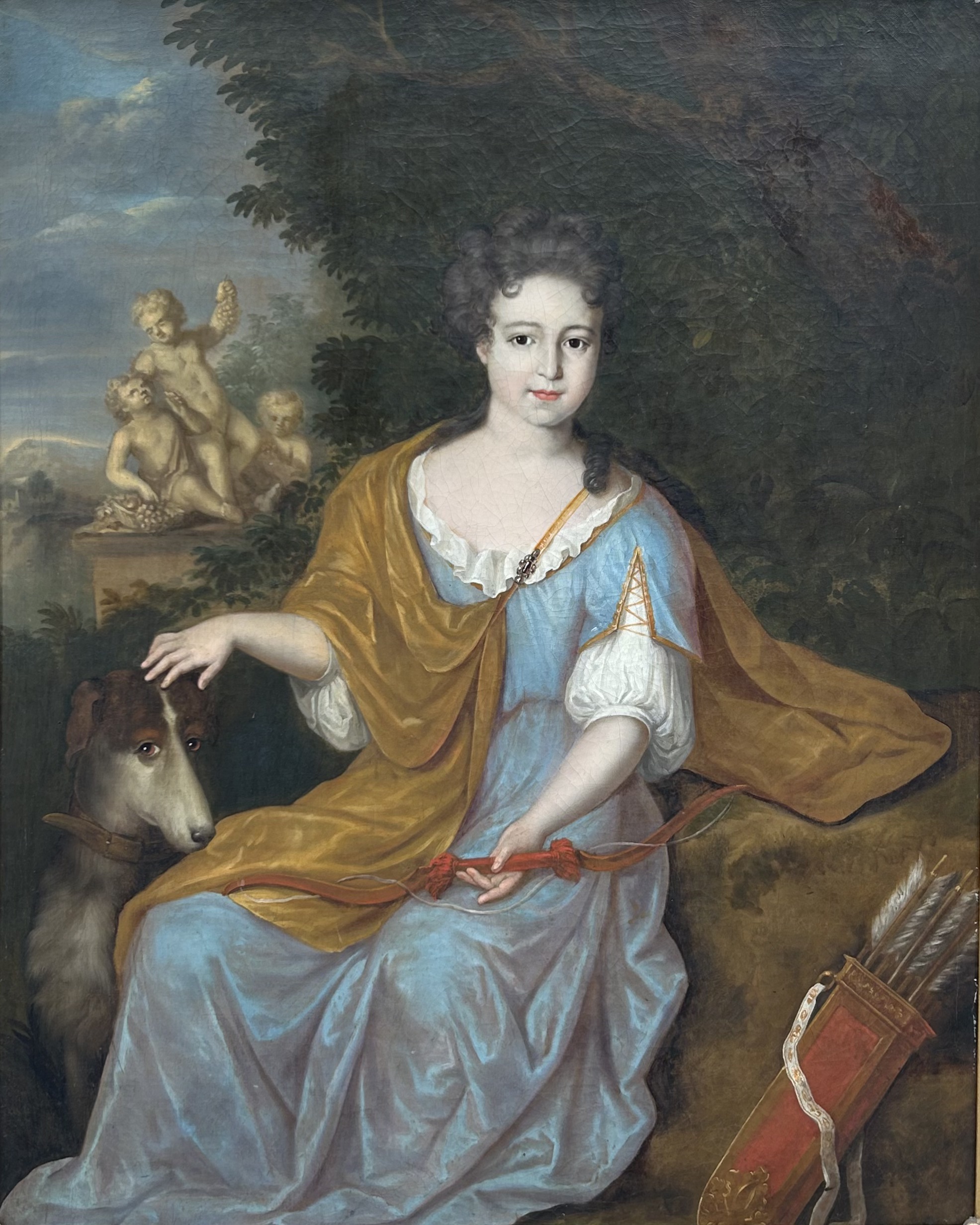

Painting depicting Joan of Arc, produced between the late 17th and early 18th century.
The identification of Joan of Arc, known as the “Maid of Orléans,” is first supported by the Latin inscription: “Virago Aurelianensis, profligatis debellatisque Anglis, ad sexus sui miraculum ovans.” This translates literally as: “The warrior woman of Orléans, having routed and defeated the English, triumphing to the astonishment of her own sex.”
Secondly, Joan of Arc’s iconography, up until the mid-19th century, is based on two main models. The first refers to the bronze monument erected in the 16th century on the bridge of Orléans, where the heroine is depicted kneeling in armour. The second, more widespread, derives from the tradition known as the “Jeanne des échevins,” a work preserved in the Musée des Beaux-Arts of Orléans (1581, inv. A.6922), which portrays a female figure closer to depictions of Judith in painting. In this version, Joan is no longer shown in armour but wearing a dress, a cap adorned with five feathers, and holding a sword raised toward the sky as a symbol of justice. This second iconographic tradition became more popular, as evidenced by the numerous engravings derived from it that have survived.
France, late 17th – early 18th century.
Height: 190 cm
Width: 126 cm