

Large-scale folding screen depicting hunters and their dog in the midst of action. The scene unfolds within a lush green landscape, with a château visible on the horizon. The four central panels are framed by arabesque and scrolling motifs set against a blue background. The reverse, more understated in style, features turquoise chamfered rectangles.
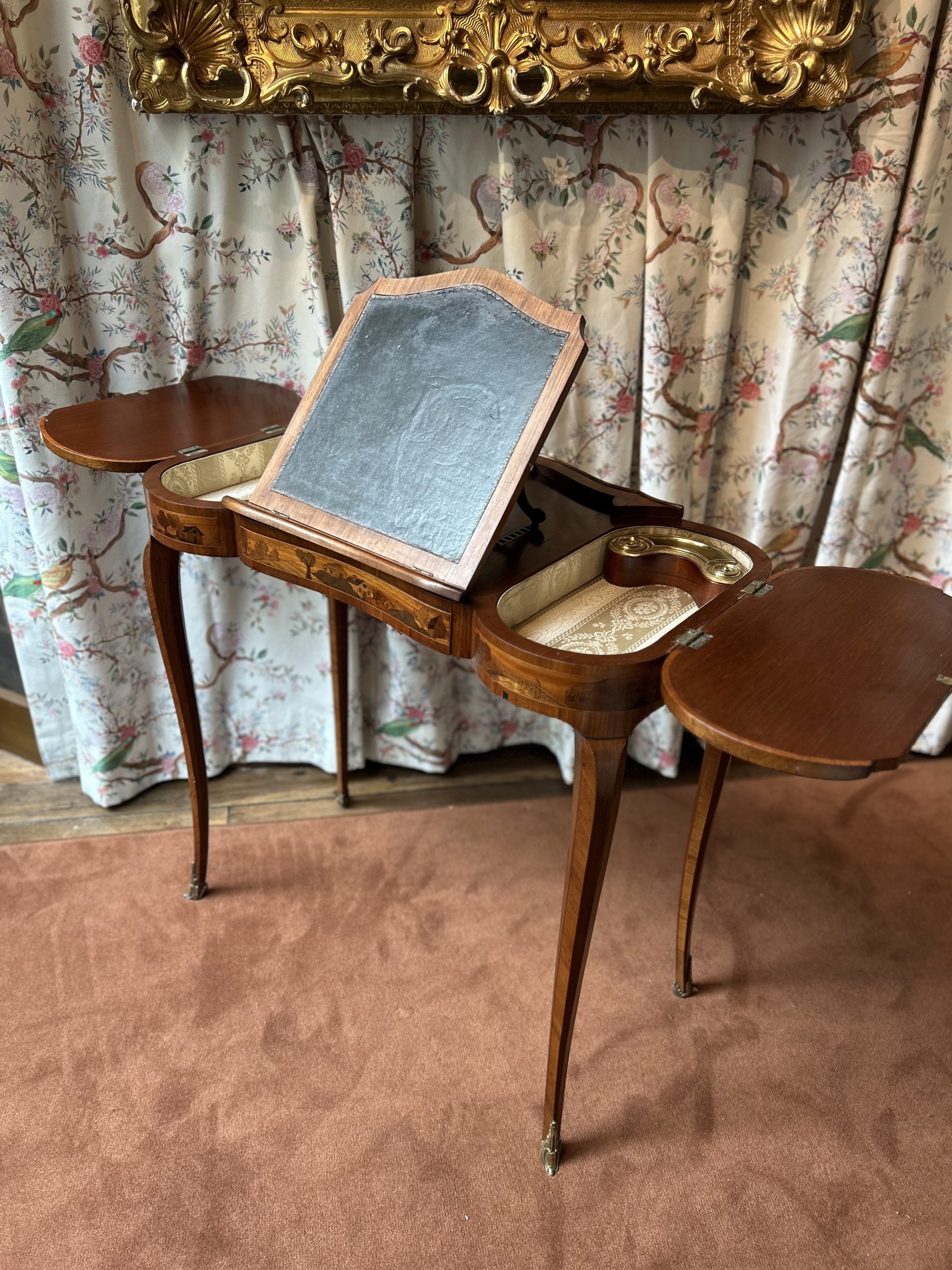
A magnificent kidney-shaped table from the Napoléon III period, perfectly embodying the Louis XV tradition through the elegance of its lines and the refinement of its craftsmanship. The ingenuity of Maison Gouffé lies in the practicality of this charming piece of furniture. The central section, fitted with a leather writing surface, is hinged and can be used either as a writing desk or a reading stand. On either side, two small compartments provide storage space, one of which contains a complete writing set.

Double-sided folding screen composed of six lacquered and finely carved panels, inspired by the productions of the Qing dynasty and the Coromandel style.

Japanese table with a fully foldable top and base, forming a compact and functional ensemble. This type of furniture is characteristic of early 19th-century production in the Kiso region, renowned for the quality of its woodworking. The tabletop features a refined decoration, enhanced with delicate marquetry that reflects highly skilled craftsmanship. With the elegance of its proportions and the finesse of its ornamentation, this table is both a practical and decorative piece.

Folding armchair with a faux bamboo wooden frame, set on an X-shaped base. The seat and backrest are in stretched black leather, held in place by side straps.
20th century

The piece is a delightful example of the taste for Orientalism and fine furniture during the Second Empire.
France
19th Century
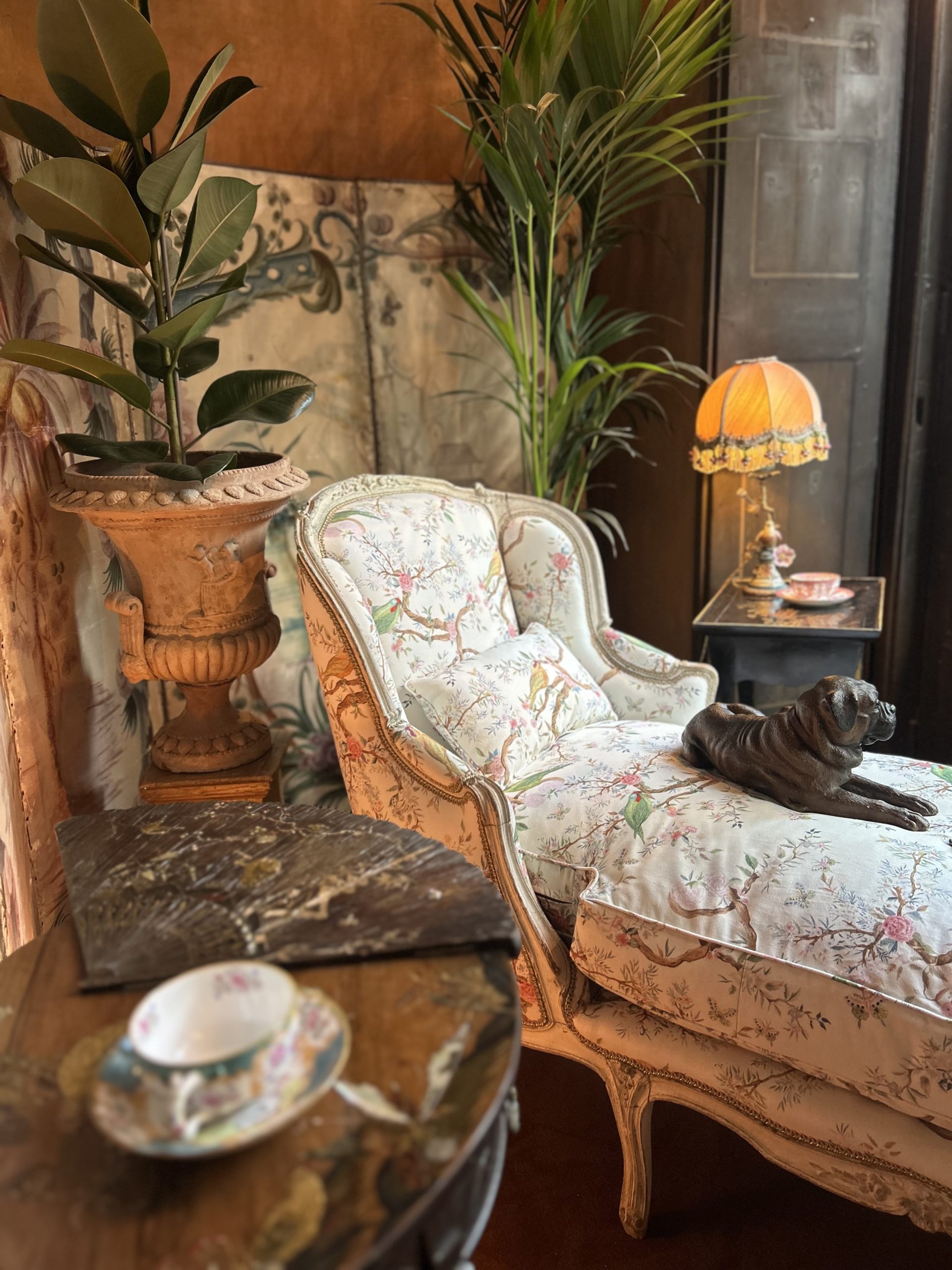
Completely restored according to traditional methods, this chaise longue has been reupholstered in a fabric designed by Tatiana de Nicolay for the Tevenon company, adding a touch of timeless elegance to the piece.
France, 19th Century

A true masterpiece of 18th-century Venetian art, this bench embodies all the theatricality and refinement of the palaces of the Serenissima. Its carved and gilded wooden frame, with its sinuous curves, reflects elegance in an exotic style typical of the Rococo taste.

A rare and elegant living room set comprising a sofa and two armchairs, attributed to the renowned Swedish designer Carl Malmsten (1888-1972), a major figure in 20th-century Nordic design.
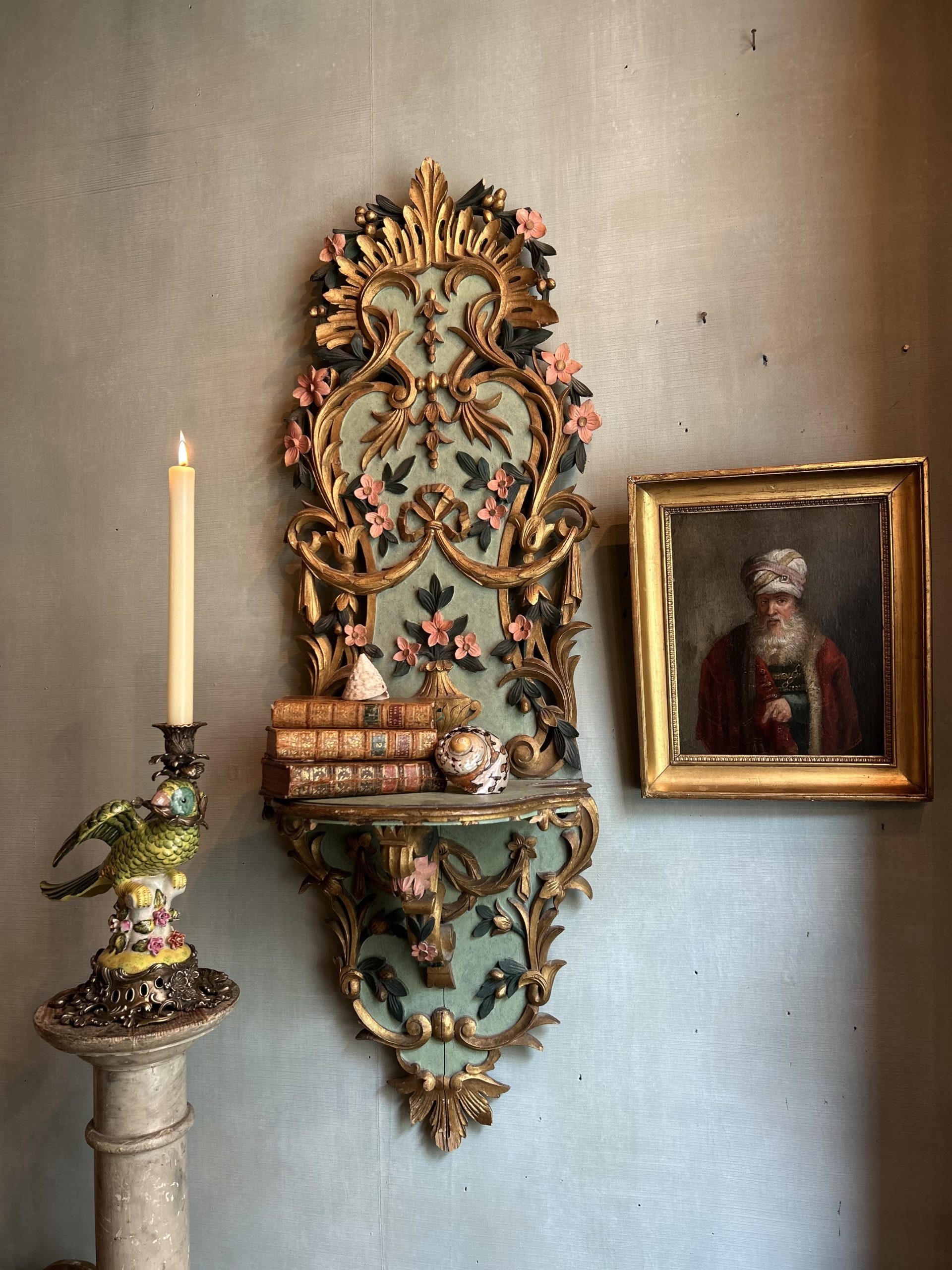
The decoration of this turban stand is characteristic of the Rococo style introduced to the Ottoman Empire during the Tulip Period, a time of openness to Western artistic influences in the 18th century. The decorative technique employed, known as Edirnekâri, refers to a tradition of sculpture and polychromy developed by artisans in the city of Edirne, in western Turkey.
Ottoman Empire, Turkey
Late 18th century