

Important paneled mirror from Beaucaire, South of France, its wooden frame composed of a flowers and foliage decor and surmounted by a central cartridge with a basket of openwork flowers.
XVIIIth century, Provence, France

This large-format painting depicts the Last Judgement. The scene shows an angel holding a trumpet, accompanied by two cherubs, standing on a cloud and holding the eternal Gospel, on which we can read in Latin: ‘Timete Dominum, quia venit hora judicii ejus: et adorate eum, qui fecit caelum, et terram, mare, et fontes aquarum.’ This warning is preceded in the texts by: “Then I saw another angel flying in the zenith. He had an eternal Gospel to proclaim to all the inhabitants of the earth, to every nation, tribe, language and people. He cried out with a loud voice: Fear God and give him glory, for the hour has come when he will judge. Worship him who made the heavens, the earth, the sea and the springs.” This is a passage from the Apocalypse of St. John 14:7.
In this painting, we can see an iconographic variation that focuses mainly on the tone given to this scene. While most representations of the Apocalypse depict this scene with an intention of gravity and “chaos”, this painting seems, on the contrary, to announce good news, the triumph of good over evil, of God over Satan.
While depictions of the Last Judgement often show a contrast between the peace of heaven and the chaos on earth, this is partly to highlight the ‘heavenly glory’ of the righteous in contrast to the wicked, who will suffer eternal shame and torment. This eschatological thinking was central to society in the 15th and 16th centuries, as the ‘end of the world’ was a source of great concern to the population.
While this iconography is widely developed in many religious buildings, through frescoes and sculpted tympanums, we can also see it incorporated into tapestry and painting.

Pair of blue and white porcelain parrot wall lights by Wong Lee. These depict blue and white parrots perched on a tree trunk, holding a gilded bronze scroll in their beaks. The whole piece is mounted on gilded bronze bases. The lamps are fitted with new green silk-lined lampshades and Declercq trimmings.

This portrait fully illustrates the graceful and elegant style of the school of Hyacinthe Rigaud (Perpignan, 1659 – Paris, 1743), a major figure in portrait painting during the reigns of Louis XIV and Louis XV, characterized by a subtle blend of classical idealization and meticulous attention to detail.

Created in the style of apprentice furniture or pieces used to demonstrate skills, it testifies to great craftsmanship.
The front, composed of two drawers, is decorated with painted motifs imitating objects: necklaces, ribbons, keys, and fabrics appear to be suspended or placed on the piece with striking realism.
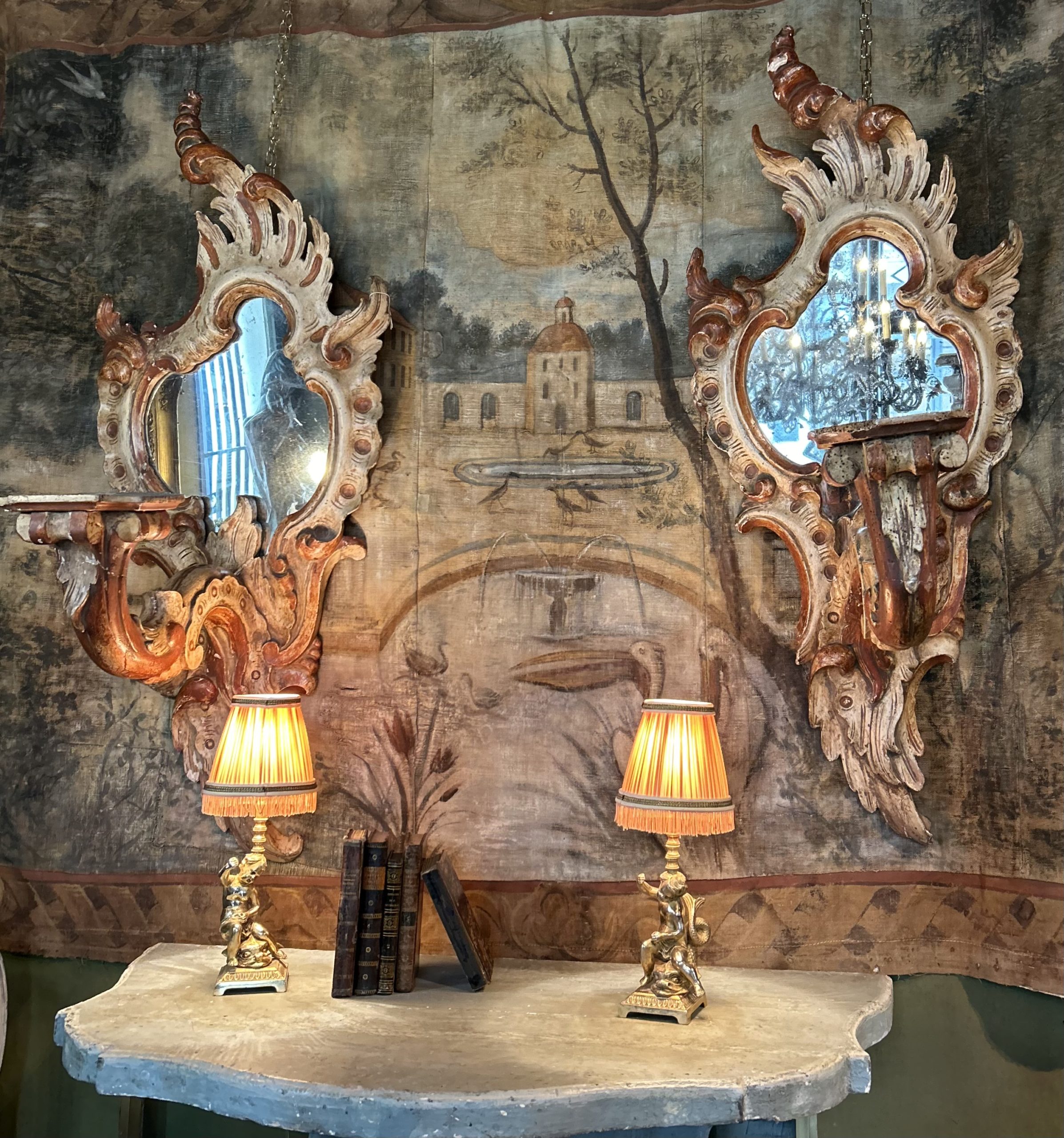
Pair of scones with a central mirror and an arm of light in carved and lacquered wood with rocaille decoration of volutes, shells and foliage.
XVIII century
Venice, Italy

Pair of dog-shaped lamps in polychrome porcelain and gilded bronze, in the Meissen style, with new green silk lampshades lined with green silk and Houlès trimmings.

750 yellow gold cross set with twelve garnets.

18th-century carved and silvered wooden mirror, decorated with intertwining foliage, leaves, and flowers. This mirror is quite exceptional due to its size and silver color.

18th-century six-light “lace” chandelier, composed of a turned and gilded wooden structure and a set of blown glass beads and pendants. This type and name literally refer to the structure of this chandelier, which consists of a “lacing” of iron wires onto which glass beads are threaded, creating a mesh that was highly prized for its diffusion of light.