
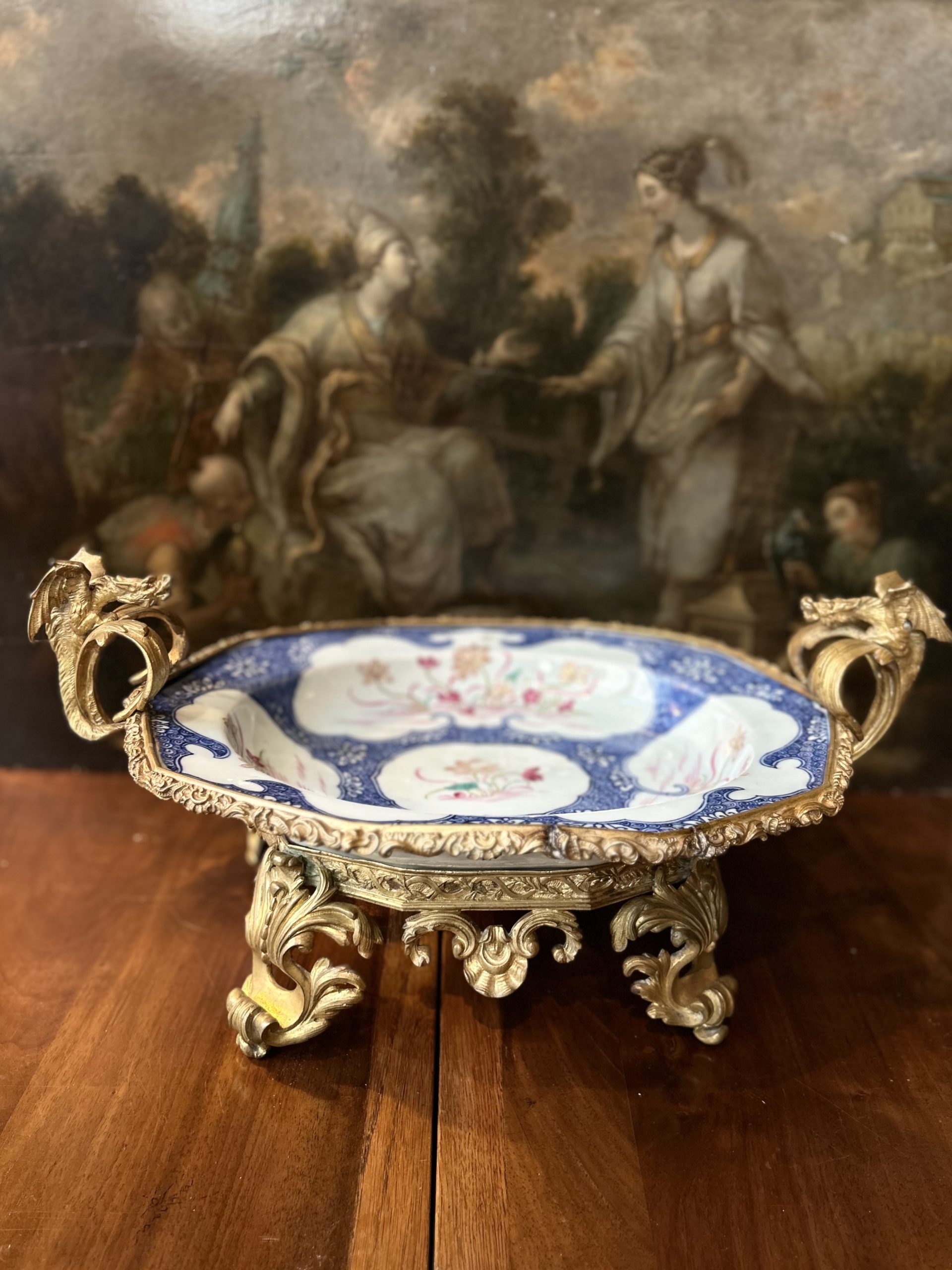
It consists of a deep Imari-type porcelain plate, in particularly bright colors, deep blue, bright white and intense red.
The gilded bronze frame is in keeping with the spirit typical of the Louis XV style.
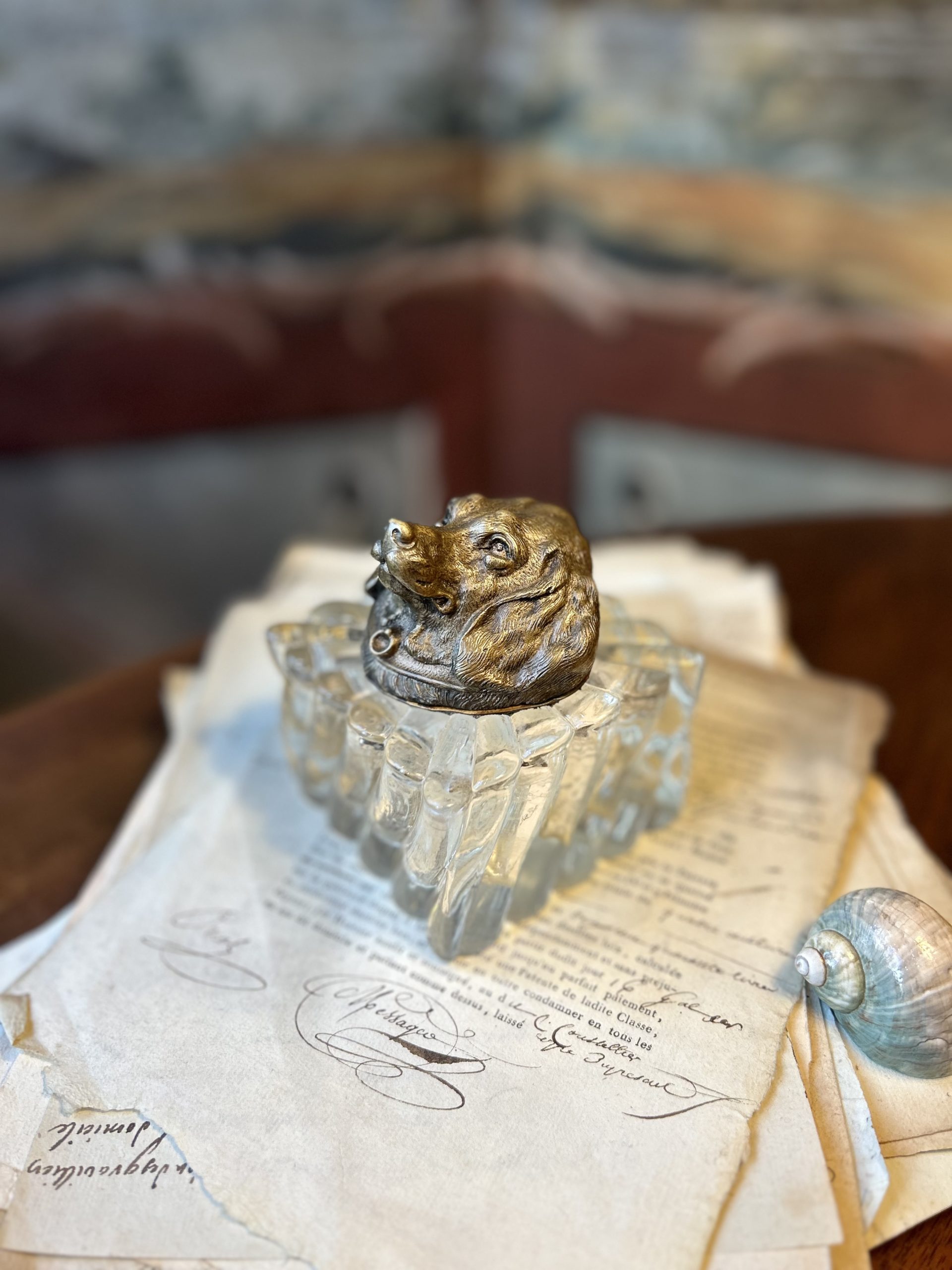
Today, it can also be used as a paperweight, while retaining its decorative charm and unique presence.
France
Late 19th century

Their pierced backrests in painted sheet metal illustrate fables by Jean de La Fontaine, some of which are taken from the illustrated repertoire of Jean-Baptiste Oudry, produced between 1729 and 1734: The Hare and the Tortoise, The Wolf and the Dog, The Donkey and the Dog, The Frog and the Rat, The Fox and the Monkey King…
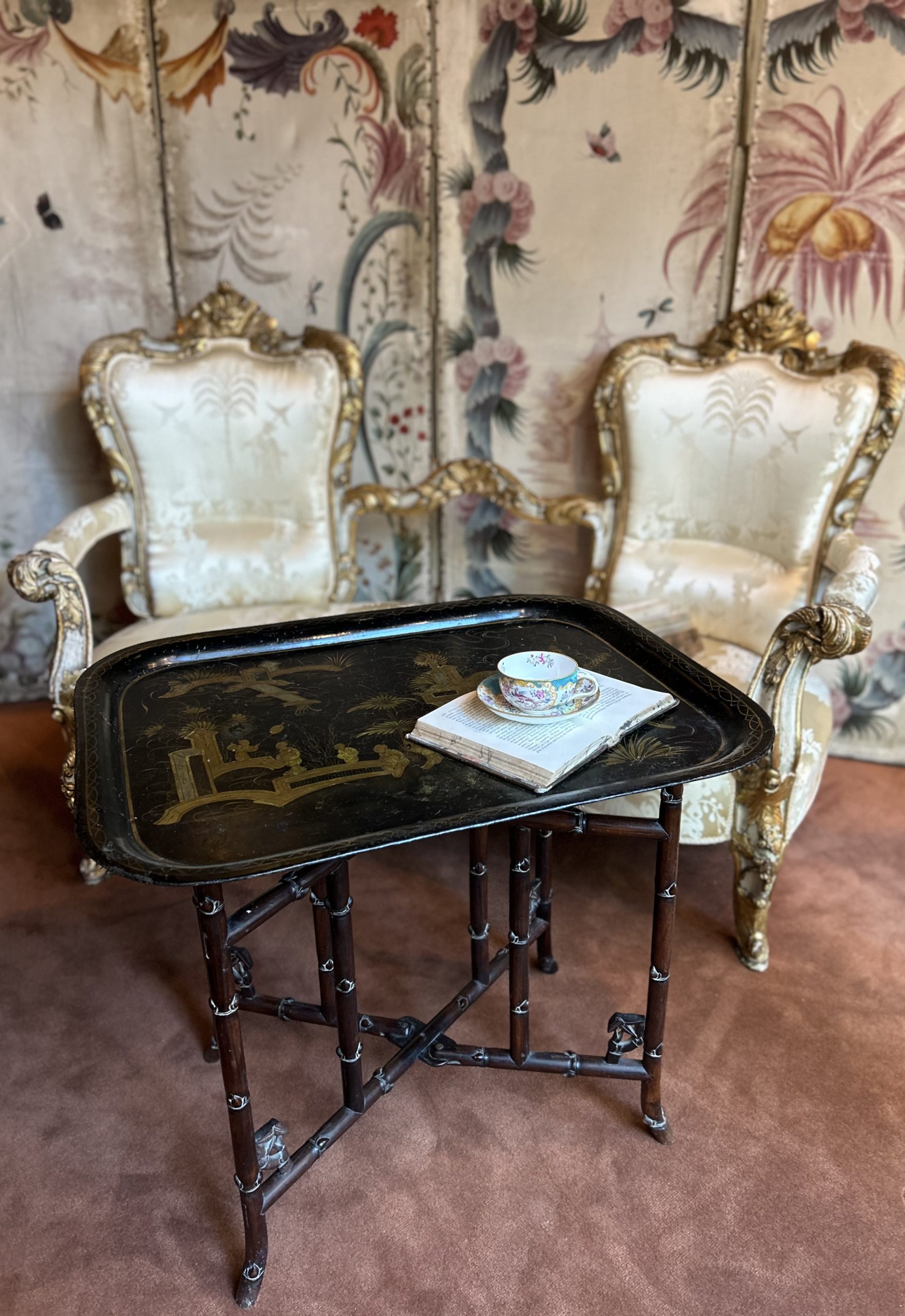
Charming Napoleon III period coffee table with a rectangular top featuring raised edges, decorated with a Japanese-style genre scene against a black background.
France XIX century
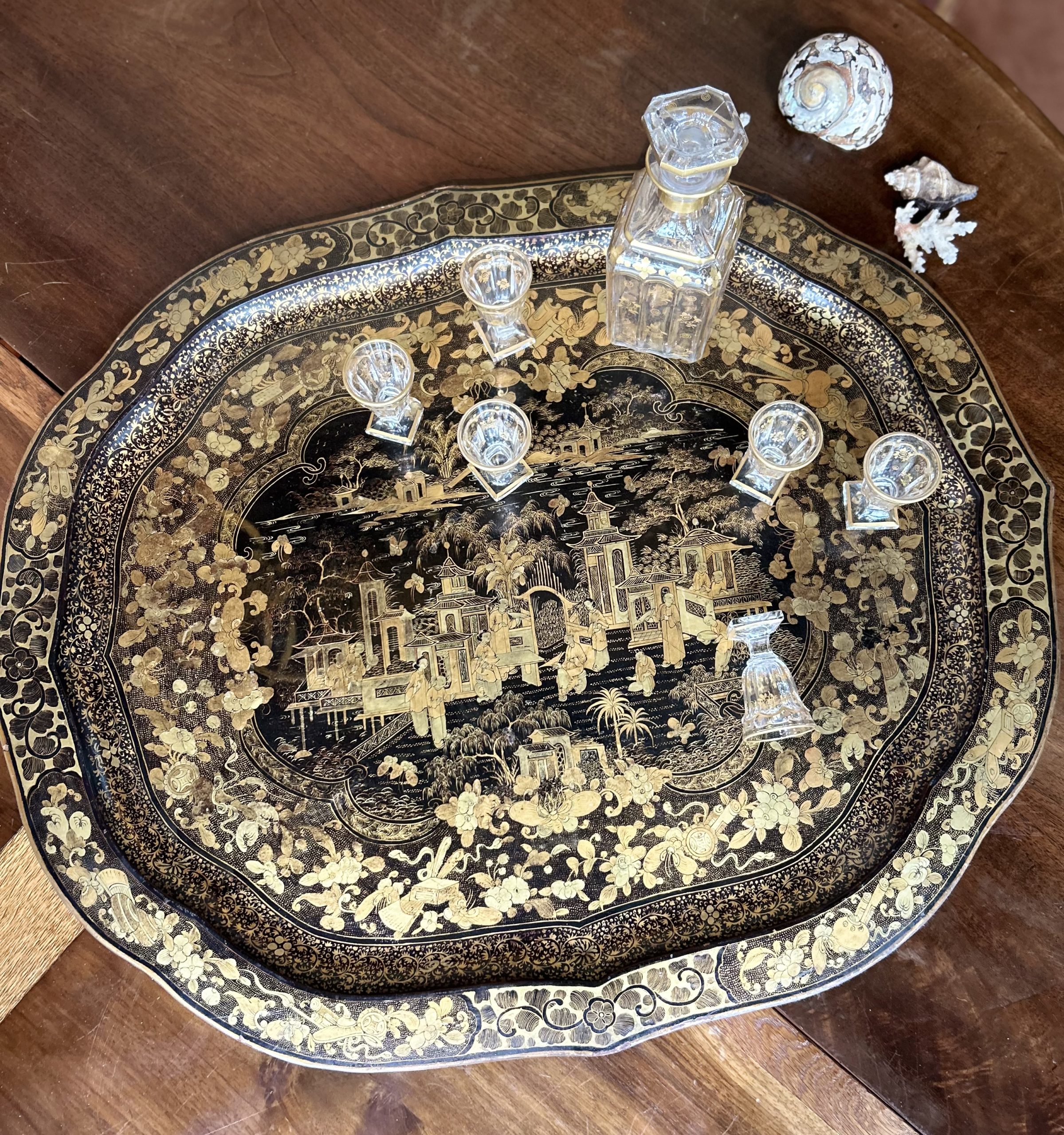
Primarily used for serving tea, it is a fine example of a Cantonese export item, combining the exoticism of Far Eastern landscapes with the refinement of the Second Empire style.
France, 19th century

At the time, this was an expensive and prestigious item, intended for a wealthy clientele. These mirrors were sold particularly at the major fairs of Beaucaire, a strategic town located on the banks of the Rhône, then the main communication route between the Mediterranean and the interior.
France, 18th Century
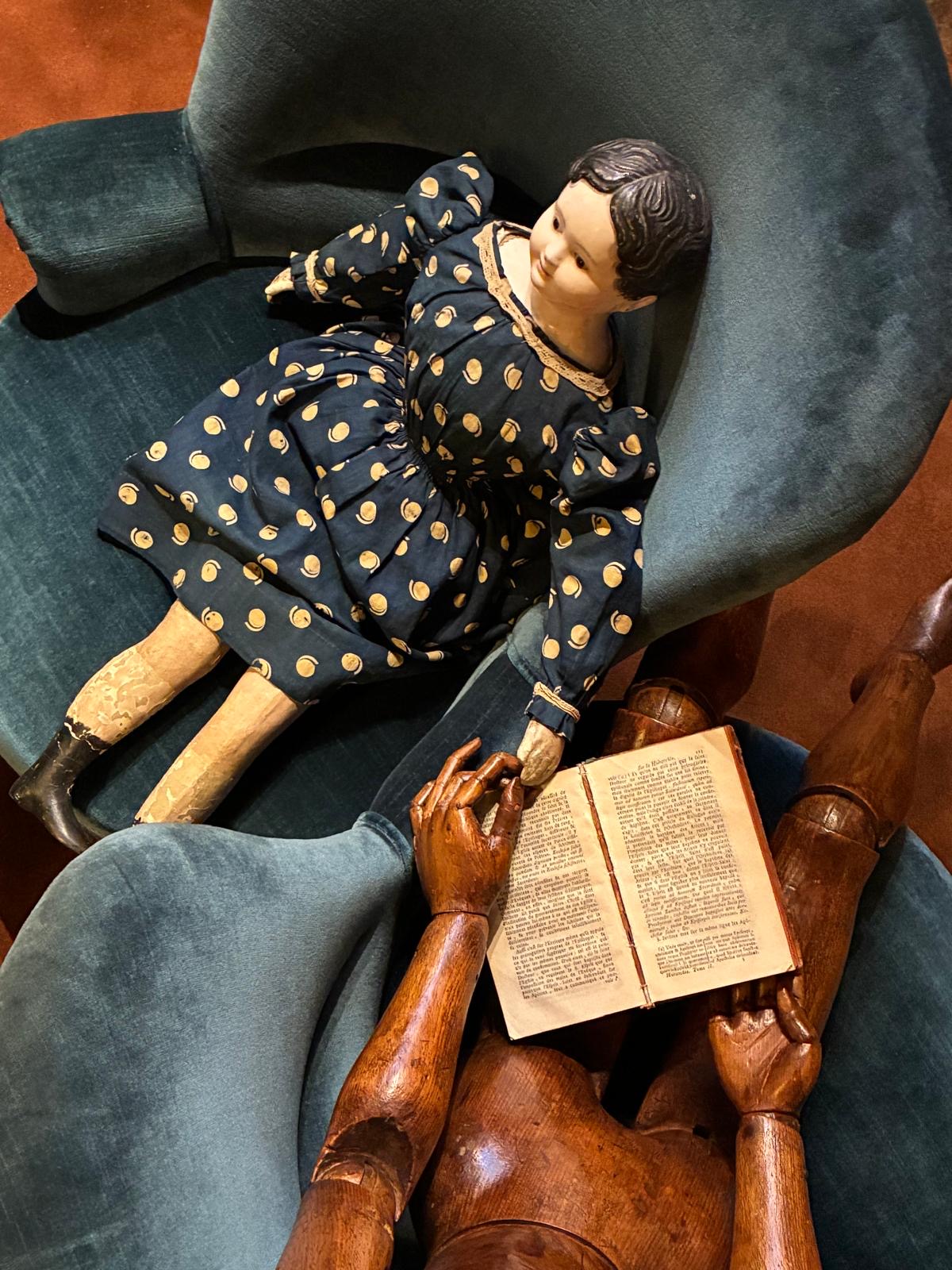
“The confidant, also called a conversation chair, vis-à-vis chair, or tête-à-tête chair, is a double armchair in an S shape that allows two people to talk without having to turn their heads. This piece of furniture is an invention of the Second Empire. It can also be triple, or even multiple, with several S-shaped chairs joined or aligned; this is then called an indiscreet chair.
The confidant was very fashionable during the reign of the French leader Napoleon III. It is a typical piece of furniture found in the “boudoirs and antechambers of power.”

Important paneled mirror from Beaucaire, South of France, its wooden frame composed of a flowers and foliage decor and surmounted by a central cartridge with a basket of openwork flowers.
XVIIIth century, Provence, France

This large-format painting depicts the Last Judgement. The scene shows an angel holding a trumpet, accompanied by two cherubs, standing on a cloud and holding the eternal Gospel, on which we can read in Latin: ‘Timete Dominum, quia venit hora judicii ejus: et adorate eum, qui fecit caelum, et terram, mare, et fontes aquarum.’ This warning is preceded in the texts by: “Then I saw another angel flying in the zenith. He had an eternal Gospel to proclaim to all the inhabitants of the earth, to every nation, tribe, language and people. He cried out with a loud voice: Fear God and give him glory, for the hour has come when he will judge. Worship him who made the heavens, the earth, the sea and the springs.” This is a passage from the Apocalypse of St. John 14:7.
In this painting, we can see an iconographic variation that focuses mainly on the tone given to this scene. While most representations of the Apocalypse depict this scene with an intention of gravity and “chaos”, this painting seems, on the contrary, to announce good news, the triumph of good over evil, of God over Satan.
While depictions of the Last Judgement often show a contrast between the peace of heaven and the chaos on earth, this is partly to highlight the ‘heavenly glory’ of the righteous in contrast to the wicked, who will suffer eternal shame and torment. This eschatological thinking was central to society in the 15th and 16th centuries, as the ‘end of the world’ was a source of great concern to the population.
While this iconography is widely developed in many religious buildings, through frescoes and sculpted tympanums, we can also see it incorporated into tapestry and painting.

Pair of blue and white porcelain parrot wall lights by Wong Lee. These depict blue and white parrots perched on a tree trunk, holding a gilded bronze scroll in their beaks. The whole piece is mounted on gilded bronze bases. The lamps are fitted with new green silk-lined lampshades and Declercq trimmings.