


A set of six wooden chairs entirely clad in repoussé silver leaf, featuring interlacing patterns, scrolling foliage, and floral motifs. The backrest is adorned at its ends with two rams’ heads in relief, lending the set a highly decorative character.

This cast iron garden bench reflects the Victorian taste of the second half of the19th century. Its structure features naturalistic decoration with scrolling foliage, vine leaves and other botanical motifs. The backrest and seat are entirely piercedwith an openwork design. The whole rests on two finely worked legs, connected by metal reinforcing elements.

Pair of “bistro” side tables in black lacquered cast iron, with stone tops. They rest on a pedestal base terminating in three claw feet, bearing the inscription “Paris.”

Elegant armchair stool of serpentine form, resting on four cabriole legs terminating in scroll feet, with carved decoration of foliage and shells. The seat and apron are upholstered in an elegant textile with a polychrome floral design on a cream ground, lending the piece a certain delicacy. The particularly finely worked apron is centred with a carved rocaille motif.

This elegant center table is distinguished by its scalloped, lacquered black papier-mâché top—featuring a recessed center—adorned with a delicate medallion depicting a woman’s portrait, surrounded by gilded arabesques and scrolling foliage. A truly remarkable and rare feature is that the table comes with its complete set of nine matching original lacquered papier-mâché coasters, each finely decorated with *chinoiserie* and Asian-inspired scenes highlighted in gold.

Large-scale folding screen depicting hunters and their dog in the midst of action. The scene unfolds within a lush green landscape, with a château visible on the horizon. The four central panels are framed by arabesque and scrolling motifs set against a blue background. The reverse, more understated in style, features turquoise chamfered rectangles.
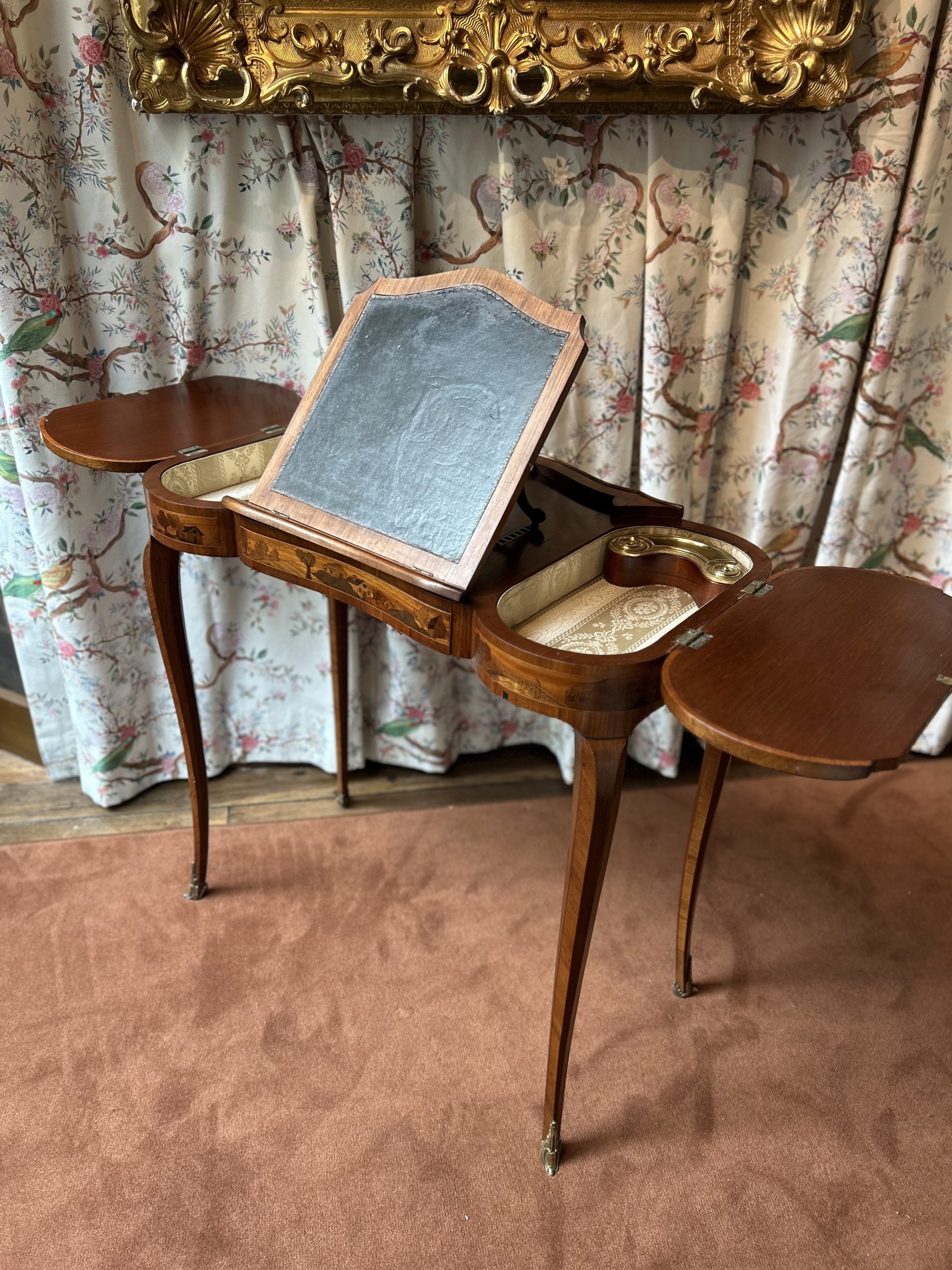
A magnificent kidney-shaped table from the Napoléon III period, perfectly embodying the Louis XV tradition through the elegance of its lines and the refinement of its craftsmanship. The ingenuity of Maison Gouffé lies in the practicality of this charming piece of furniture. The central section, fitted with a leather writing surface, is hinged and can be used either as a writing desk or a reading stand. On either side, two small compartments provide storage space, one of which contains a complete writing set.

Double-sided folding screen composed of six lacquered and finely carved panels, inspired by the productions of the Qing dynasty and the Coromandel style.

Japanese table with a fully foldable top and base, forming a compact and functional ensemble. This type of furniture is characteristic of early 19th-century production in the Kiso region, renowned for the quality of its woodworking. The tabletop features a refined decoration, enhanced with delicate marquetry that reflects highly skilled craftsmanship. With the elegance of its proportions and the finesse of its ornamentation, this table is both a practical and decorative piece.