

Important openwork yellow gold pendant with a lace-like design, crafted using the granulation technique, which creates raised decoration through the application of minute gold granules. The cross is adorned with oval faceted amethysts and white gemstones mounted over foil, all set in closed, millegrain settings.

Charming openwork cross, crafted in gold and outlined around its perimeter with a fine black enamel border. It is set with eight rose-cut diamonds, including one on the bail, designed in the form of a bow. This detail of the bail is particularly reminiscent of the so-called “Louis XVI” cross. Each arm terminates in a fleuronné motif.

This type of regional jewel is known as the “Heart of Mary” (Vlaamse Hart), which translates as “Flemish Heart.” Originating in Antwerp, its production began in the late eighteenth century. There are two variations of this jewel: one surmounted by a crown of flowers, and the other adorned with a quiver of arrows and a flaming torch. Our pendant belongs to the latter category and was traditionally given as a token of love. Its silver interlaced decoration is set with small rose-cut diamonds, as well as a larger diamond at the center of the pendant.

This type of regional jewel is known as the “Heart of Mary” (Vlaamse Hart), which translates as “Flemish Heart.” Originating in Antwerp, its production began in the late 18th century. Our example is decorated with silver interlacing set with small rose-cut diamonds, together with a larger diamond at the center of the pendant. The whole is surmounted by a crown of flowers.

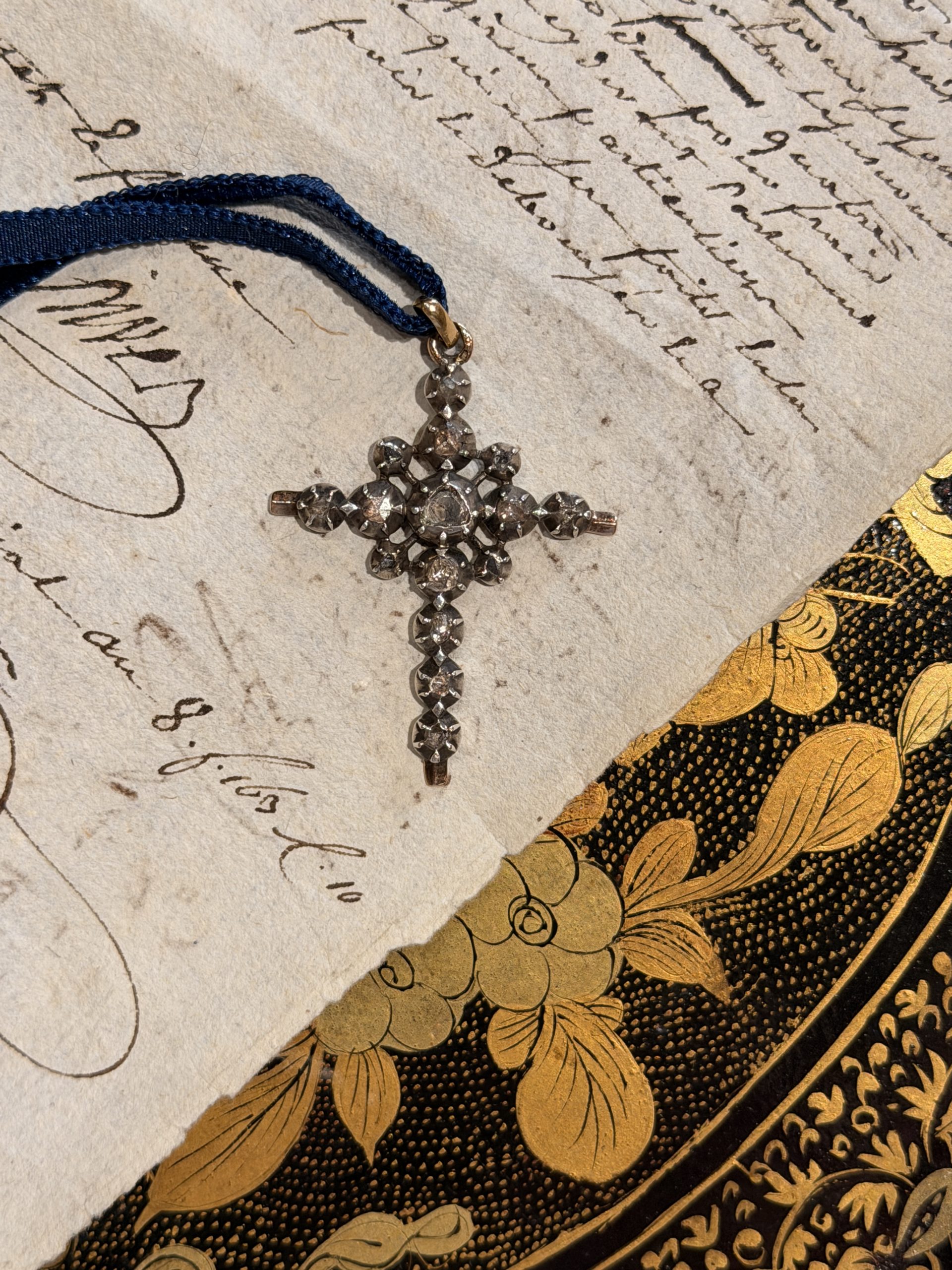
Pendant in the shape of a cross, situated at the meeting point between two models. Indeed, its shape clearly refers to the “Marie-Antoinette” cross, which was nonetheless surmounted and supported on the chain by a bow, an element absent on our cross. These crosses are characterised at their centre by a rounded form, created by the arrangement of the stones in relation to one another.

Large Saint-Lô cross accompanied by its neck chain. This jewel was mainly worn in Lower Normandy. Very widespread in the 18th century, this cross continued to be produced in the 19th century. Craftsmen of the second half of the 19th century, keen to reproduce models similar to those of the previous century, painted a small black dot on the back of the stones to give them an older appearance. This detail therefore allows us to date our cross to the second half of the 19th century.

Small pendant in the form of a Provençal “butterfly cross,” composed of four rhinestones and a movable drop-shaped element surrounded by silver scrolling foliage.

An elegant oval miniature attributed to Robert Field (1769–1819), depicting a bust-length portrait of an admiral in his blue uniform, adorned with epaulettes and gold embroidery. The sitter is shown in three-quarter view against a delicately shaded blue background, highlighting the refined features of his face.

750 yellow gold cross set with twelve garnets.