

Important openwork yellow gold pendant with a lace-like design, crafted using the granulation technique, which creates raised decoration through the application of minute gold granules. The cross is adorned with oval faceted amethysts and white gemstones mounted over foil, all set in closed, millegrain settings.

Pair of lidded Delft earthenware vases, accompanied by an octagonal-sectioned conical vase. All three pieces are decorated with floral motifs set within scalloped cartouches. The reverse side, meanwhile, features a more understated design consisting of a single flower.
While Delftware designs are traditionally characterized by shades of blue, this set stands out for its use of a purple palette. The lids of the two vases are topped with lion-shaped finials, their heads turned.

This plate has a lace-patterned rim and is decorated with stylised irises on a delicate, water-green background. This piece was produced by the Karl Rudolf and Friedrich Ditmar factory in Znaim, Austria.
Rudolf founded the artistic ceramics factory in Znaim in 1879, originally specialising in the production of earthenware lampshades. The factory also produced porcelain pieces.

A refined white marble sculpture depicting the Infant Jesus asleep, delicately reclining on his side in a peaceful posture of slumber. His charming face, with its soft features, is framed by fine, gracefully falling curls; the nude body—modestly draped with a light cloth around the hips—demonstrates great anatomical finesse and a beautiful Neoclassical sensibility.
Italy, 19th century

The composition follows the classic arrangement in which the Archangel Gabriel—wings unfurled and wrapped in swirling drapery—bows to the left before the Virgin, offering her a lily (a symbol of purity), while the Virgin Mary, clad in a sky-blue mantle and a pink robe, pauses in her reading to receive the divine message.
Giltwood frame
Italy, 18th century
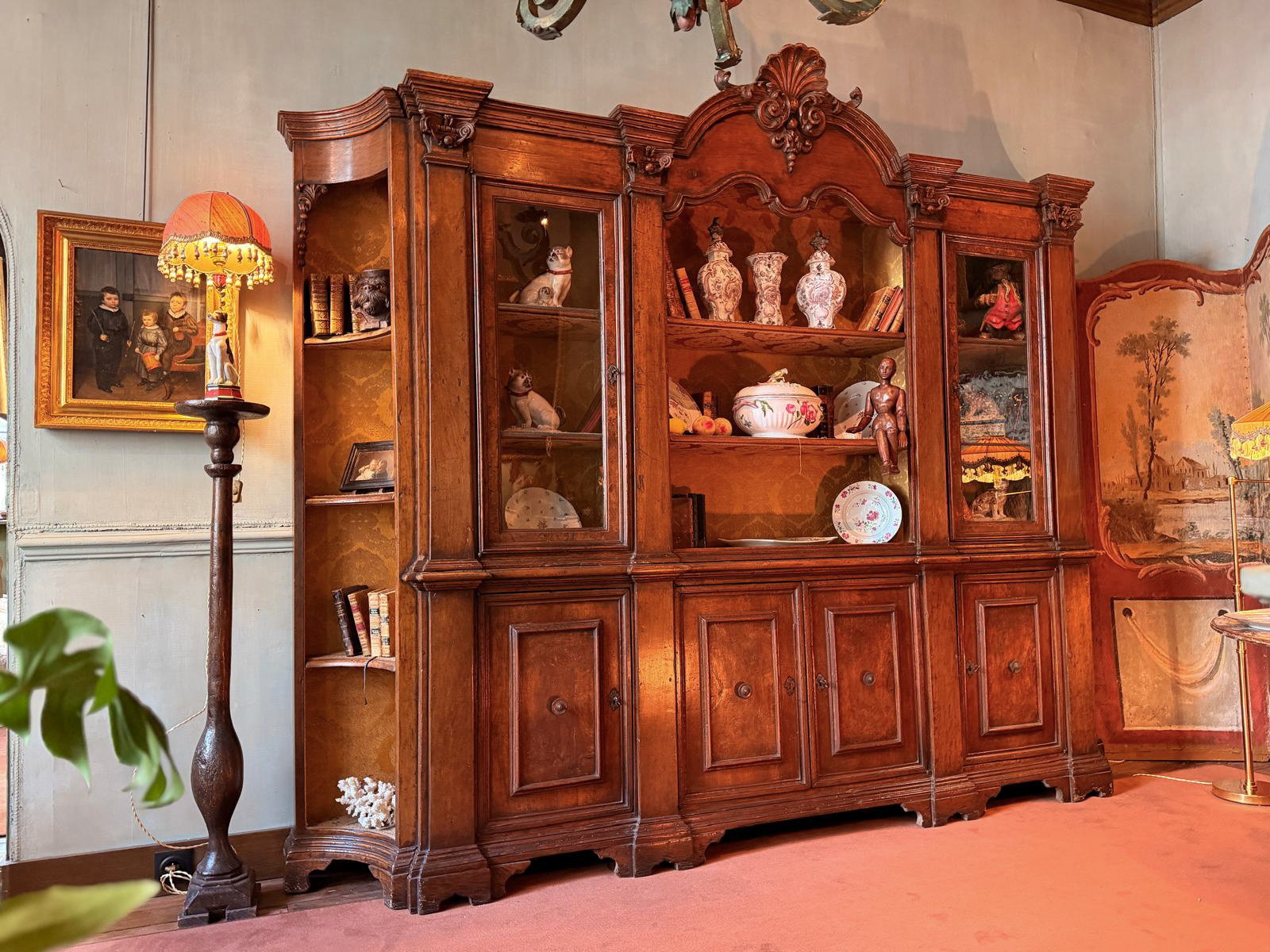
This bookcase is distinguished by its theatrical architecture. At the center, an imposing pediment features moldings and a carved *rocaille* shell framed by acanthus leaves. The upper section presents a striking interplay of glazed sections, a central arched open bay, and curved side shelves. The pilasters are elegantly topped with carved capitals featuring volutes.
Italy
18th century

Gold cross pendant set with seven rose-cut diamonds, including one on the suspension loop.

This painting depicts a lady of rank, dressed in an elegant blue velvet gown adorned with gold passementerie and a pink satin drapery covering her right shoulder. She is portrayed three-quarter length and wears a hairstyle that may evoke that of her presumed model, Mlle de Fontanges.
Although the identity of this woman remains unknown, she undoubtedly belonged to the French nobility of the eighteenth century. The quality of the painting, particularly evident in the refined rendering of the fabrics and lace, suggests an attribution to the workshop of François de Troy, who excelled especially in the treatment of such details. Also noteworthy is the hazy brown background, which can be found in several works by this great portraitist.

This mirror, made of carved and lacquered wood, features a chinoiserie decoration, or chinoiseria, composed of scrolling foliage and figures enhanced with gilding. The fascination with this Oriental-inspired imagery emerged as early as the 17th century and spread throughout Western Europe during the 18th century. Italy was no exception to this trend, and Venice in particular became known for producing a wide variety of lacquered furniture decorated with chinoiserie motifs.

This glass bottle contains a composition made primarily from various materials, including wax and cut paper. This type of object is known as a “Passion bottle” because it contains the Instruments of the Passion of Christ, also known as the Arma Christi. Among them are the cross, the nails, the rooster, the ladder, the column of the Flagellation, and others.
This work belongs to a tradition of folk art in which boatmen and bargemen carefully crafted these votive objects (ex-votos) as a gesture of thanksgiving for a fulfilled vow, often related to the hazards and uncertainties of navigation. These objects were frequently placed in small shrines located in chapels, homes, or even in the cabins of boatmen.